


Drawing on ADM Capital’s 26 years of experience investing in Asian credit, we have distilled key market observations. We recognize that private credit is becoming an increasingly core and strategic asset class for investors, offering stable and attractive returns across market cycles. However, market dynamics in Asia are not homogeneous; factors such as managers’ experience, credit strategies, fund structures, valuations and correlation to other major asset classes are crucial for investors to consider. Read on for more insights from Sabita Prakash, Managing Director and Chair of the Investment Advisory Committee at ADM Capital.
Market Dynamics in Asia are Different
The private credit market globally has increased threefold over the last decade from $440 billion to $1.7 trillion[1]. The APAC private credit market has doubled in size over the past five years according to Preqin, though still accounts for only ~7% of the global market.
Such rapid growth in a less liquid and mainstream asset class does give pause for thought. From our vantage point of 26 years of experience, we see innumerable use cases for private credit across cycles and particularly essential for growing regions such as Asia, where technology, infrastructure, education and demographics have created strong tailwinds. We see private credit as a critical solution in supporting this growth.
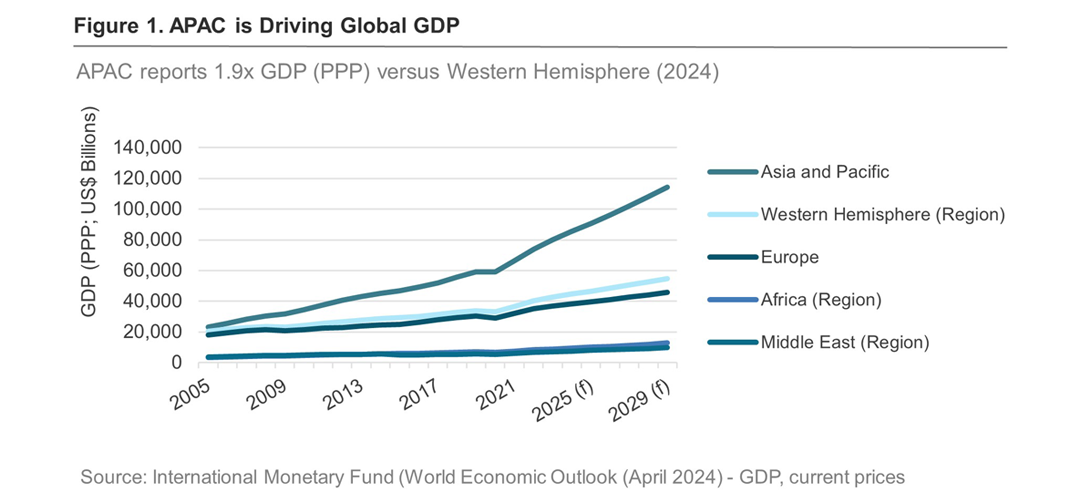
Executed correctly, private credit strategies can provide a stable, consistent and high risk-adjusted return detached from market cycles, macroeconomics or politics. Such consistency of performance should allow for private credit to be an important allocation in any investor portfolio that has a long-term investment horizon.
Banking Depth and Sponsor Involvement Varies Regionally
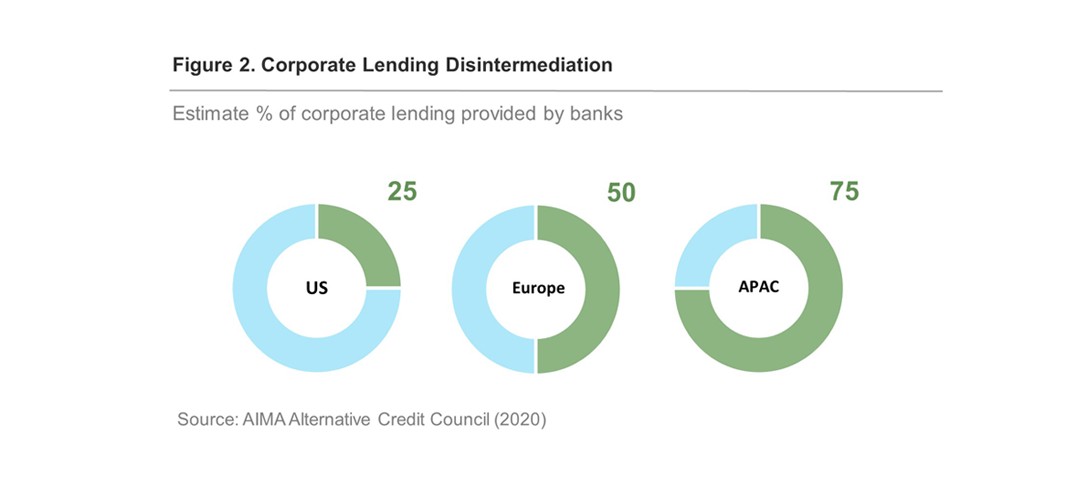
In Asia, private credit funds provide essential support to a constrained banking sector which still dominates corporate lending activity. APAC banks’ typically have meaningful exposure to real estate and are under pressure from regulators to increase provisions and disintermediation is expected, but it will take time. Research suggests banks are beginning to re-enter the private credit market in North America and Europe as they seek fees to replace syndicated lending, particularly in the upper market/ large-cap segment.
Direct, Bi-Lateral and Non-Sponsored Lending Solutions
There is limited negative contagion in Asia given that the majority of private credit is non-sponsored, meaning that investment activity is less reliant on M&A trends and private equity performance. In the US, the number of lenders in single direct lending loan facility has been steadily increasing, averaging 2.53 in 2023 (Figure 3). In the Asian mid-market segment, funds are typically able to underwrite the entire financing, ensuring control in the event of default and an ability to take effective remedial action. This is essential to the preservation of capital.

Approximately 70% of private credit deals in the US were sponsored by private equity firms in 2023. In Q3 2022, a Deloitte report noted that in Europe, sponsor-led direct lending activity accounted for 89% of the market in the UK, and 85% in the rest of Europe. The ratio of the private equity to private debt assets under management is 30.8x for APAC compared to a much tighter 5.2x and 3.5x for the United States and Europe[2]. Private credit funds in Asia tend to provide highly structured and innovative corporate financing solutions that differ from the more standardised US and European direct lending models.
Lack of Correlation and a Private Equity Approach to Private Debt
In the Asia mid-market segment, given the lack of sponsored deals, the alternative creditor assumes the role akin to a sponsor, conducting private equity-style due diligence, using covenants and management oversight and Board participation to ensure effective governance and monitoring on an ongoing basis.
APAC represents a diverse lending environment across ~14 countries. For pan-regional managers, portfolios are less exposed to single political or economic shocks. ADM Capital has managed assets through several destabilising domestic events – government changes, regulatory developments, currency volatility, geopolitical tensions, Covid-19 responses, and being a truly regional participant is helpful in ensuring allocations are diversified and dynamic in response to macro events. Economies in Asia are driven by uncorrelated factors, suggesting that the pattern of demand for credit will continue to change, but is dependably persistent on a regional basis.

Yields remain attractive in private credit and investors are compensated for the illiquidity. In APAC, where fixed income markets are concentrated amongst real estate developers, quasi-sovereign issuers or financials, the liquidity and diversification in public fixed income markets (largely unsecured) is limited.
In the US, JP Morgan suggests direct lending deals yield a 250bps premium over high yield public market transactions and most loans adopt floating rates.[3]
Borrowers in Asia remain willing to pay a premium for the speed and certainty of execution, agility, and customization that private lenders offer. Higher for longer rates have created challenges for borrowers but in Asia, where we target 15% gross contractual returns, and have tended to use fixed interest rates to ensure companies have certainty over their liability.
Most importantly, the artisanal process of originating and structuring each transaction, ensuring optimum risk-return trade-off and appropriate downside protection, should deliver alpha vs. high yield bond markets which tend to be built on scaled propositions, involving unsecured and oftentimes quite highly correlated risks. Specifically in Asia, investors are financing assured growth that is more efficiently executed via debt, as compared to US and European markets that depend on squeezing costs to improve margins or financial engineering that involve substantial leverage to achieve target returns.
Asia Lacks Alternative Credit Supply
Media coverage reports excessive growth in private credit dry powder and continued competition with banks that could further compromise underwriting standards in the US and European markets.
Dry powder has grown tremendously in private credit – particularly in direct lending – and relative to 2014, global dry powder has nearly quadrupled. Asia’s credit vacuum remains in contrast to North America, where private credit fundraising records continue to be broken. As at Jun-24, Asia accounted for only 3% of private debt funds in market, when considering target fundraise amounts.

In the US, the largest 10 private debt fund managers are estimated to hold about 40-45% of all dry powder across all private debt strategies.
The alternative credit universe is diverse. The asset class comprises sub-strategies ranging senior secured direct lending, special situations/ capital solutions and asset backed finance, allowing funds to support young businesses via early-stage venture credit and rescue late-stage businesses through distressed debt and restructuring.
The credit product is not new, having been the traditional purview of the banking industry. Recent global economic developments have resulted in more specialised demand for credit – first, the conglomerate model is not as pervasive, with the demands of sustainability and technology necessitating the setup of more specialised companies. Second, as part of their growth plans, corporates are preferring to grow across borders rather than within their own countries. As such, these companies’ funding needs are not correlated to economic cycles as much as they are to industry specific factors. Traditional funding has not been able to keep up with these changes, in comparison with private credit which tends to be nimbler and more flexible solution to assessing risk-return trade-offs in the underwriting process. Private credit should be viewed as a “stepping stone” in preparing these companies for the rigours of public markets down the line.
Independent Valuations & Appropriate Fund Structures
The lack of liquidity and obvious valuation benchmarks can ostensibly make any private asset class less transparent than their public counterparts. Furthermore, specific to private credit, the breadth of the market and availability of multiple options attracts numerous participants with overlaps, including banks, shadow banks (finance companies), pension funds and insurance companies among others.
Pension funds, insurance companies and asset managers are identified as the major investors in APAC private credit funds, constituting approximately 75% of total investments made by investors in APAC[4]. Regulators have raised the concern of contagion risk, particularly concerning open-end funds and fund/ deal-level leverage. Admittedly, in some Asian markets like Australia and India, inflows into this asset class have been so strong that they have pushed down returns by 1-3% over the last 2-3 years, while risk has stayed the same or in many cases increased given rising interest rates.
ADM Capital believes that there are several remediating factors that offset this risk. The self-liquidating nature of private credit transactions makes it less unpredictable than private equity and shorter tenors make it easier to capitalise on fast changing economic trends. Furthermore, for the most part, investors in private credit are dealing in the mainstream corporate sphere rather than the more esoteric early-stage ventures or late stage distressed funds.
An independent valuation process is also essential in maintaining objective and transparent marks. ADM Capital’s portfolio holdings are independently valued by a standalone agent on a quarterly or annual basis (depending on fund structure) and valuations are audited annually by a third-party auditor. Fund managers should engage third parties in the periodic review of material collateral assets and seek independent investment progress updates where possible. Most importantly, the appropriate valuation methodology – discounted cash flow, comparative analysis, market approach, asset-based, net recovery value – should be applied at the right time as exit strategies are adapted. A robust valuation framework is important in ensuring asset values are accurately and consistently estimated.
Finally, it does appear the market has shown a preference for funds which are closed-ended in structure, reducing the likelihood of liquidity mismatch and forced selling to meet investor redemption requests.

In Summary:
Private credit is becoming a more important and strategic asset class for investors and can provide stable and attractive returns through capital cycles if risks are carefully managed. Reflecting on the structural idiosyncrasies of Asia’s direct lending market, here are our five key aspects for consideration:
- Managers who have experienced many cycles and adhere to strict fundamental credit analysis of borrower fundamentals, with experience across the full spectrum of private credit, will have the toolkit to navigate a rapidly changing landscape
- Insist on diversification in geography and sector to avoid contagion risk and limit correlation within portfolios, and with public markets
- Look at average loan tenors – shorter tenors allow investment managers to take advantage of cycles and improve structures/ return-on-risk in extension discussions with their borrowers
- Mainstream vs. niche credit strategies – growth, bridge, M&A etc. may allow for more readily available exit options than only special situations, which are typically more attractively priced
- Leverage in fund structures exponentially increases risk and usage should be monitored. In this context, Asian credit funds have less need to leverage given the higher-yielding, unlevered gross investment performance
–
[2] Preqin as of March 31, 2023. APAC includes Asia and Australia
[3] JP Morgan; Four Reasons to Consider Private Credit despite the Headlines (April 2024)
[4] HKMA; The Financial Stability Implications of the Private Credit Sector in Asia-Pacific (April 2024)


